
The IPIN 2026 onsite, online and offsite Indoor Localization Competition
IPIN Competition
The IPIN Indoor Localization Competition was born in 2014 to evaluate state-of-the-art localisation systems. During the competition, an actor walks along a given path while competing systems estimate the actor's position. The path is provided by competition organisers and is kept secret until the competition day.
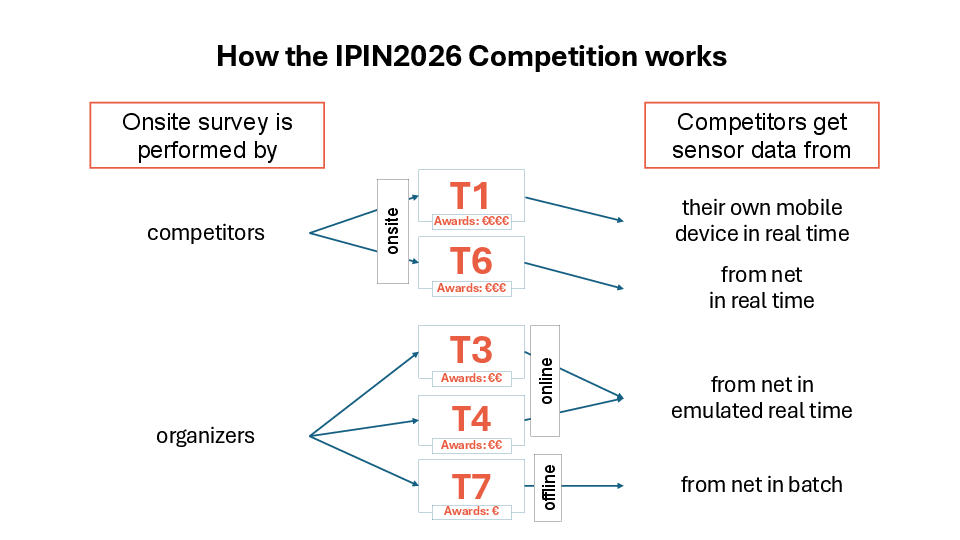
The competition comes divided into Tracks with different flavours, namely onsite Tracks, online Tracks and offline Tracks.
Onsite Tracks have competitors reading sensors data coming in real time from a mobile device (smartphone, wearable or custom, depending on the Track). During the competition day the actor holds or wears the device while following the predefined path. Competitors can survey the area the day prior to the competition. During the competition, competitors estimate the actor's position from the device sensors' readouts. For some onsite Tracks competitors develop their own application for reading sensors (for example an app on a smartphone); for other Tracks, organisers read the sensors and send the readouts to a network host which is accessed by competitors who read them back in real time. In any case, competitors provide their position estimates in real time.
Online Tracks emulate the onsite Tracks scenario by means of a dedicated web application server called EvaalAPI. Well in advance of the competition, the Track organisers log data collected from a mobile device while following a given path and store it on the EvaalAPI. During the competition day, competitors alternately download a batch of sensor readouts from the EvaalAPI (typicall half a second worth of data) and send back a position estimate before downloading the next batch of data. In contrast with onsite Tracks, online Tracks are run on emulated real time, which is slower than real time (typically 3 times slower), can accommodate occasional delays (typically up to 30s) that may be caused by the competitor's system or by network problems, and can be replayed by the server for testing purposes. You can look at our video tutorials with an introduction to the online competition and how to assess estimates; both use Track 4 as an example.
Offline Tracks are run without any regard to data timing. The Track organisers collect the sensors readout in advance, and during the compeititon competitors download the whole data set of sensors readout in a single batch. Competitors then upload the resulting estimates all at once by a given deadline (typically 10 minutes).
The IPIN competition is meant to compare the performance of real algorithm and systems in a realistic setting. It is conceptually based on the EvAAL Framework, ensuring consistent and rigorous testing conditions.
Check che Current Competition on the menu to the top to know what's going on!
This is the new IPIN Competition web site. The old web site is available as a backup of old information at https://evaal.aaloa.org/. Should you need any information that you can't find please notify us at info(at)evaal.aaloa.org.